
Ransomware, AI-powered phishing, and new HIPAA mandates are converging on healthcare. Here’s what’s changed — and the practical steps that separate protected practices from vulnerable ones.
If you run a medical practice, you’re sitting on some of the most valuable data on the internet. A single patient record sells for up to $250 on the dark web — roughly 25 times the value of a stolen credit card number. Cybercriminals know this, and they’ve shifted their focus accordingly.
2026 has brought a sharper threat landscape than most practice owners expected. The combination of AI-powered attack tools, tighter HIPAA enforcement, and increasingly distributed workflows has turned cybersecurity from an IT afterthought into an operational priority. This post covers the five risks that matter most right now — and what a protected practice actually looks like.
The 5 Threats You Need to Take Seriously Right Now
1. AI-Powered Phishing Campaigns
Generic “click here to reset your password” emails are old news. Attackers now use large language models to craft hyper-personalized emails that reference a staff member’s name, their EHR platform, and even recent appointment schedules scraped from public sources. These messages are nearly indistinguishable from legitimate internal communication — and they’re working. Phishing is the entry point in over 80% of healthcare breaches.
2. Ransomware Targeting EHR Systems
Healthcare is the number-one ransomware target globally, and the attackers have gotten more patient. Modern ransomware groups often sit inside a network for weeks before encrypting — silently exfiltrating data first so they can demand payment twice: once to restore access, and again to prevent public release. Practices without immutable, air-gapped backups have very few options when this happens.
3. The 2026 HIPAA Security Rule Overhaul
The updated HIPAA Security Rule — effective March 2026 — removed the “addressable vs. required” flexibility that many practices relied on. Multi-factor authentication, annual penetration testing, and 72-hour incident response documentation are now mandatory, not optional. Practices caught unprepared face fines starting at $10,000 per violation category, and OCR has dramatically increased audit activity.
4. Unsecured Remote & Telehealth Access
The rapid expansion of telemedicine left many practices with a patchwork of remote access tools — some personal devices, some vendor portals, some VPNs of unknown vintage. Each connection is a potential entry point. Without Zero Trust network access policies that verify every user and device before granting access, a single compromised laptop can expose an entire patient database.
5. Vendor and Supply Chain Risk
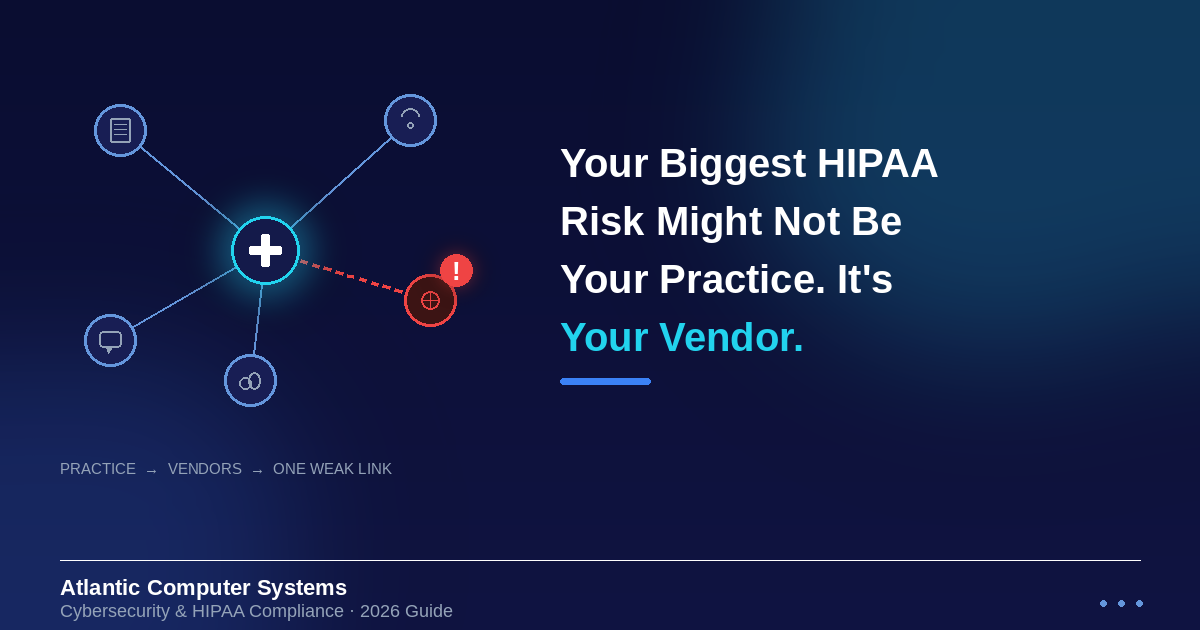
Your practice is only as secure as the third parties you trust. Billing platforms, lab portals, scheduling software, and cloud fax providers all have access to PHI — and their security posture directly affects your HIPAA liability. The 2024 Change Healthcare breach, which exposed records for roughly a third of all Americans, originated through a single vendor without MFA enabled. Business Associate Agreements are necessary but not sufficient; you need active vendor risk monitoring.
What a Well-Protected Practice Actually Looks Like
The good news: the fundamentals aren’t complicated. The practices that weather the current threat environment share a consistent set of characteristics — and none of them require an enterprise-sized IT budget.
The Case for a Managed IT Partner
Most small and mid-size medical practices can’t justify a full-time in-house IT security team — nor should they have to. A qualified managed IT provider brings enterprise-grade tooling, 24/7 monitoring, and deep healthcare compliance experience for a fraction of the cost of a single internal hire.
The key is finding a partner who understands healthcare specifically: your EHR environment, your HIPAA obligations, your patient care workflows. Generic IT support that isn’t fluent in PHI handling and regulatory timelines creates more risk than it solves.
When evaluating an MSP, look for: proactive monitoring (not just break-fix response), documented HIPAA compliance processes, a named account contact who knows your environment, and transparent pricing that doesn’t bury security tools in optional add-ons.