
If you run a small medical practice, dental office, or behavioral health clinic, HIPAA compliance can feel overwhelming. The regulations are complex, the penalties are severe, and IT security isn’t your core expertise. But compliance isn’t optional — and with the 2026 HIPAA Security Rule updates raising the bar even further, every practice needs a solid compliance foundation.
This checklist breaks down the essential HIPAA IT security requirements into actionable steps that small healthcare practices can follow to protect patient data and avoid costly violations.
HIPAA Compliance Checklist for Small Healthcare Practices
1. Complete a Security Risk Assessment
A HIPAA security risk assessment is the single most important compliance requirement — and the one most frequently cited in enforcement actions against small practices. You must identify every system that stores, processes, or transmits electronic protected health information (ePHI), evaluate the threats and vulnerabilities to those systems, and document your findings with a remediation plan.
Under the updated 2026 rules, this assessment must be conducted at least annually using a documented methodology. If you haven’t done a formal risk assessment, this is where to start. Atlantic Computer Systems offers free HIPAA security assessments to help small practices understand their current risk posture.
2. Encrypt All Patient Data
Encryption is now mandatory for all ePHI under the 2026 HIPAA Security Rule update. This means every computer, laptop, tablet, and server in your practice that touches patient data must have encryption enabled. Your email system must use TLS encryption for messages containing ePHI, and any cloud services (EHR, billing, file storage) must encrypt data both in transit and at rest.
For small practices, this often means enabling BitLocker or FileVault on workstations, ensuring your EHR vendor provides encryption documentation, and implementing encrypted email for patient communications.
3. Implement Multi-Factor Authentication
The 2026 rule requires multi-factor authentication (MFA) on all systems that access ePHI. For a small practice, the priority systems include your EHR or practice management software, your email system (especially if you communicate with patients via email), remote desktop or VPN access for any staff working off-site, and your cloud storage or backup services.
Most modern systems support MFA through authenticator apps like Microsoft Authenticator or Google Authenticator. The setup is straightforward and dramatically reduces the risk of unauthorized access from stolen or guessed passwords.
4. Maintain Up-to-Date Security Software
Every workstation and server in your practice needs current antivirus and endpoint protection software, a properly configured firewall, regular operating system and application updates (patch management), and web filtering to block access to known malicious sites.
Small practices often fall behind on patching because there’s no dedicated IT staff to manage updates. This is one of the top reasons practices partner with a managed IT services provider — to ensure security updates happen consistently without disrupting clinical workflows.
5. Train Your Staff on HIPAA Security
Human error remains the leading cause of healthcare data breaches. HIPAA requires that all workforce members receive security awareness training, including how to recognize phishing emails, proper handling of ePHI, rules for using personal devices, and incident reporting procedures.
Training should be conducted at onboarding and at least annually thereafter, with documentation showing who was trained and when.
6. Secure Your Backups
HIPAA requires that you maintain retrievable, exact copies of ePHI. Your backup strategy should follow the 3-2-1 rule: three copies of your data, on two different types of media, with one copy stored off-site. Backups must be encrypted and regularly tested to verify you can actually restore data when needed.
7. Manage Business Associate Agreements
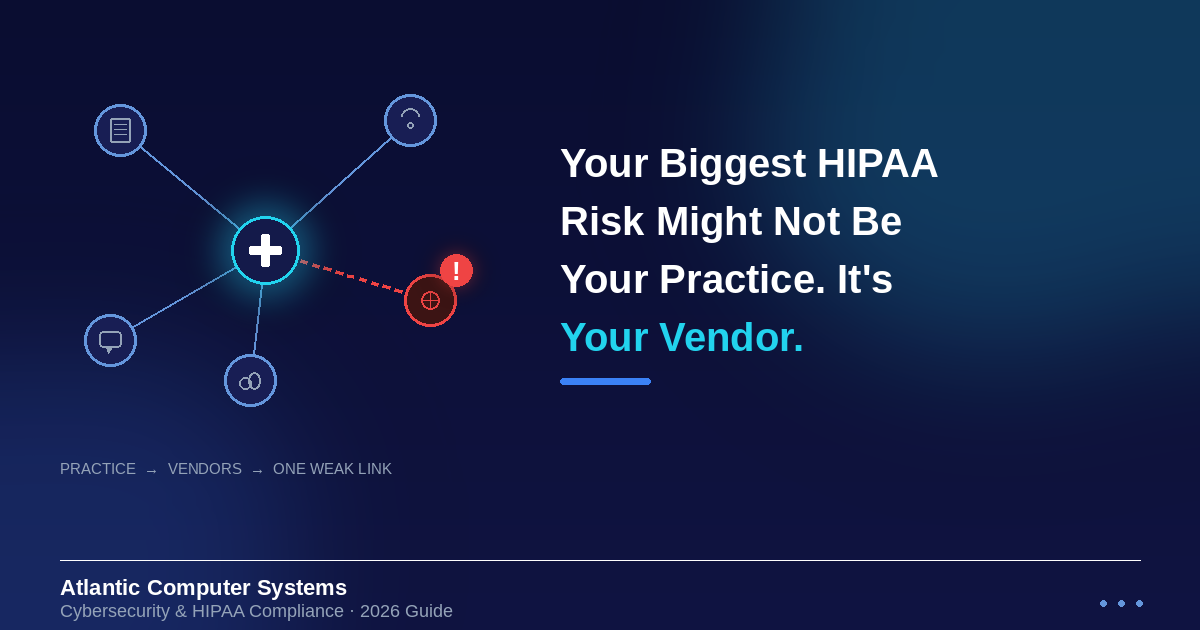
Any vendor that has access to your patients’ ePHI must sign a Business Associate Agreement (BAA). This includes your EHR vendor, IT support provider, cloud storage service, billing company, shredding service, and even your answering service if they take patient messages. Maintain a current list of all business associates and ensure every agreement is signed and up to date.
8. Implement Physical Security Controls
HIPAA isn’t just about cybersecurity. Physical safeguards matter too. Ensure server rooms and network closets are locked, workstation screens auto-lock after a short period of inactivity, paper records containing PHI are stored in locked cabinets, and you have a clean desk policy in patient-accessible areas.
9. Create an Incident Response Plan
With the new 72-hour reporting requirement, you need a documented plan for what happens if a breach occurs. Your incident response plan should identify who on your team is responsible for responding, outline steps for containing and investigating the incident, include templates for required breach notifications, and list contact information for your IT provider, legal counsel, and HHS.
10. Document Everything
HIPAA compliance is as much about documentation as it is about technical controls. Maintain current, written versions of your security policies and procedures, risk assessment reports and remediation plans, staff training records, BAA inventory, and incident response logs. In an OCR audit, the question isn’t just “do you have security controls?” — it’s “can you prove it?”
Don’t Go It Alone: Get Expert HIPAA IT Support
Small practices face the same HIPAA requirements as large hospital systems, but with a fraction of the IT resources. That’s where a HIPAA compliant managed IT services provider makes the difference. At Atlantic Computer Systems, we work with small and mid-size healthcare practices across California to implement, monitor, and maintain the IT security controls that HIPAA demands.
Get your free HIPAA security assessment to find out where your practice stands and get a clear roadmap to full compliance.